Aims and Scope

The Journal of Emergency Practice and Trauma is an Open Access free of charge and double blind peer-reviewed journal which provides an international forum for communication among health professionals with clinical, academic, and research interests in emergency practice. The journal gives particular emphasis to papers that integrate the findings of academic research into realities of clinical practice in the following areas:
Clinical Toxicology, Environmental Emergencies, Resuscitation, Anesthesiology, Emergency Ultrasonography, Disaster Medicine, Traumatology, Trauma Surgery, Critical Care, Internal Medicine, Cardiac Emergencies, Pediatrics Emergency Medicine, Behavioral Emergencies, Emergency Medical Services, Emergency Nursing and any other research related to emergency practice.

JEPT adheres to ICMJE and follows the guidelines of the Committee on Publication Ethics (COPE) recommendations.


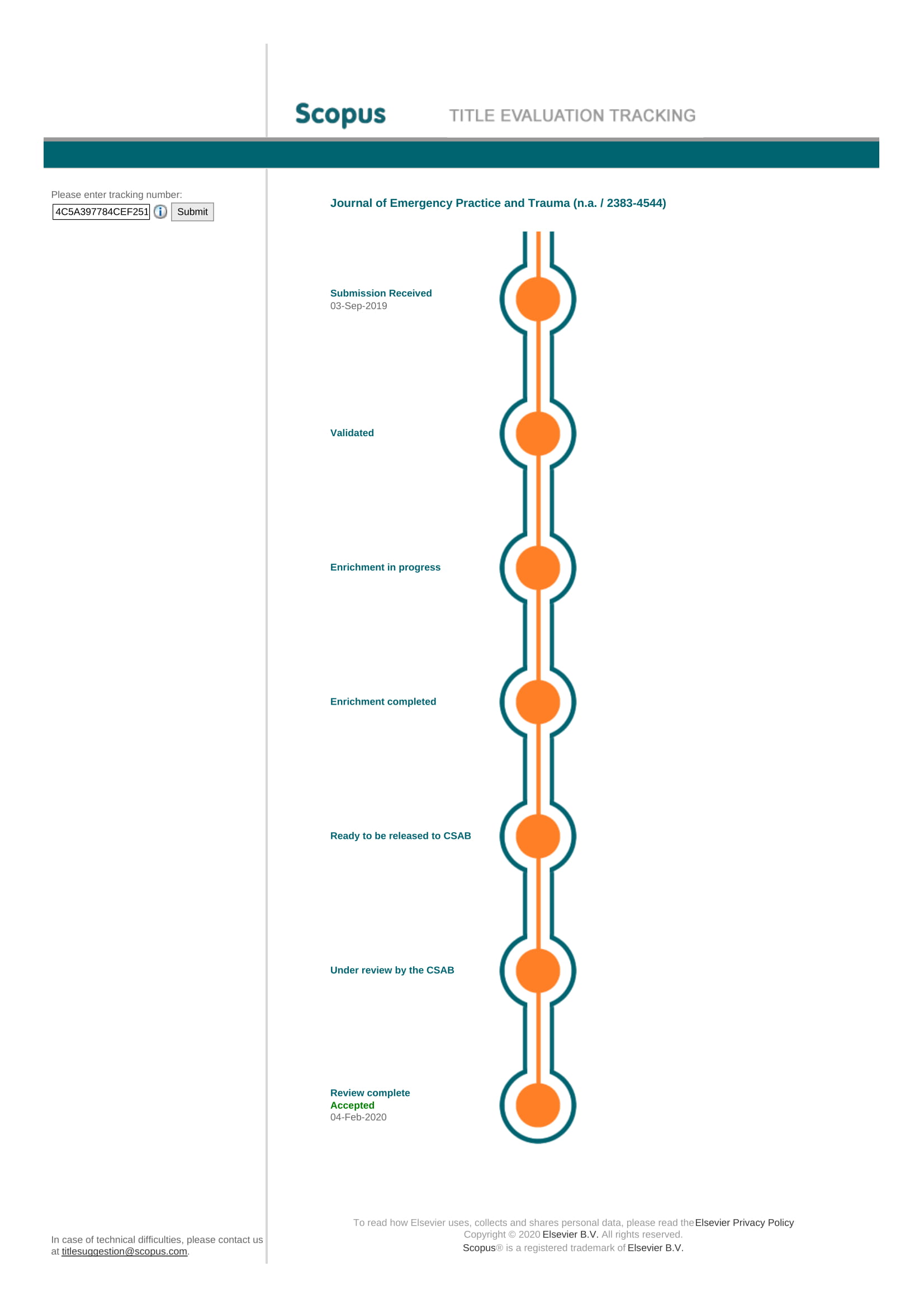
We are pleased to announce that Journal of Emergency Practice and Trauma (ISSN: 2383-4544) has been accepted for inclusion in Scopus by Content Selection and Advisory Board (CSAB).

The CSAB has advised that the title is accepted for inclusion in Scopus.


APPROVAL OF SCIENTIFIC-RESEARCH RANKING

The Journal of Emergency Practice and Trauma was approved at the 115th session of the National Medical Journals Commission of Iran on 14/Feb/2016 as a scientific-research journal.


Review Article Emergency Medical Services

A Systematic Review of Road Traffic Accidents in India: Epidemiology, Risk Factors, Prevention Strategies, and Post-Crash Care (2020–2025)

Izmir Gadi, Ravi Yadav

Abstract Background: Road traffic accidents (RTAs) remain a leading cause of morbidity and mortality in India, disproportionately affecting young adults aged 15–39 years. Despite multiple road safety initiatives, the burden of road traffic injuries remains high, with wide variation in epidemiology, behavioral risk factors, and trauma care delivery. Understanding recent trends and determinants is essential for designing effective, evidence-based interventions.

Purpose: This systematic review aimed to synthesize contemporary evidence (2020–2025) on the epidemiology of RTAs in India, associated risk factors, injury patterns, and preventive strategies.

Methods: A systematic literature search was conducted in PubMed/MEDLINE, Embase, Google Scholar, and Indian journal repositories for studies published up to August 31, 2025, following PRISMA 2020 guidelines. Eligible studies included hospital-based observational studies, community and population surveys, forensic autopsy studies, qualitative research, surveillance reports, and relevant reviews conducted in India. Case reports and multinational studies without disaggregated Indian data were excluded. Study quality and risk of bias were assessed using the Newcastle–Ottawa Scale for observational studies and established qualitative appraisal frameworks. Due to heterogeneity in study designs and outcomes, findings were synthesized narratively.

Findings: Forty-five studies met inclusion criteria. RTAs predominantly involved males aged 21–40 years, with two-wheelers being the most commonly affected vehicles. Key risk factors included non-use of helmets and seatbelts, alcohol consumption, and speeding. Head and limb injuries were the most frequently reported injury patterns. Deficiencies in timely transport and pre-hospital care emerged as critical gaps. Qualitative evidence highlighted behavioral barriers to road safety compliance and challenges in traffic law enforcement.

Implications: RTAs continue to pose a major public health challenge in India, driven by interconnected behavioral, environmental, and systemic factors. Strengthened traffic enforcement, improved road infrastructure, and robust pre-hospital trauma care systems are urgently required. Future research should evaluate the effectiveness of targeted policy interventions and technological innovations in road safety management.

Cardiology

Hyperkalemia-induced complete heart block

Volume 1, Issue 1, January 2015, Pages 35-38

Alireza Baratloo, Pauline Haroutunian, Alaleh Rouhipour, Saeed Safari, Farhad Rahmati

Abstract Background: Potassium, as an extracellular ion, plays an important role in the electrophysiologic function of the myocardium and any change in extracellular concentration of this ion might have a marked impression upon myocyte electrophysiologic gain. High serum potassium levels are thought to impair pulse conduction in Purkinje fibers and ventricles more than that in the Atrioventricular (AV) node. Therefore, although complete AV block can occur, it is a rare initial presentation.
Case Report: We describe a 62-year-old man with a history of diabetes mellitus, ischemic heart disease and previous Coronary Artery Bypass Graft (CABG), who came to our emergency department due to generalized weakness starting 2 days before admission. The patient also had decreased force in lower limbs, exacerbating from the morning, and was finally diagnosed as a hyperkalemia-induced Complete Heart Block (CHB). It should also be noted that the patient responded dramatically to the administration of 10 mL of 10% calcium gluconate along with external pacing until potassium level correction became effective.
Conclusion: In spite of the fact that Hyperkalemia can be associated with frequent Electrocardiogram (ECG) abnormality, advanced heart blocks (second- and third-degree AV blocks) are usually found only in patients with pre-existing heart failure, conduction abnormalities, or other cardiac diseases. Institution of effective treatment rapidly and forgiveness of traditional non-effective, time consumptive and sometimes risking full-adjustment modalities, such as sodium bicarbonate infusion or exchange resins that prevent their use in the emergent phase, can help minimize patient morbidity and mortality.

Trauma

A road to ethics: a new experience of retraction

Volume 2, Issue 1, January 2016, Pages 1-2

Hafez Mohammadhassanzadeh, Amin Beigzadeh, Mehrdad Nazarieh

Abstract Every journal finds its fundamentals in the course of time by the validity and originality of its published literature. This is validated if authors keep diligence and honesty when they conduct their research and submit their work in a journal. But at times what comes out of a scientific research is not always valid and reliable because there has not been an appropriate control on the work or researchers did not thoroughly conduct and report the results. Thus, it is very important that journals keep an increasingly close eye for the detection of scientific misconduct.  

Emergency medicine

Using risk factors to help in the diagnosis of acute myocardial infarction in patients with non-diagnostic electrocardiogram changes in emergency department

Volume 1, Issue 1, January 2015, Pages 3-6

Ali Arhami Dolatabadi, Parvin Kashani, Hamidreza Hatamabadi, Hamid Kariman, Alireza Baratloo

Abstract Objective: This study aimed to determine the association of cardiac risk factors and the risk of Acute Myocardial Infarction (AMI) in Emergency Department (ED) patients with non-diagnostic ECG changes.
Methods: This cross-sectional study was conducted in the ED of Imam Hossein Hospital during a period of one year. In this study, patients with symptoms suggestive of AMI including chest pain, dyspnea, palpitation, syncope, cerebrovascular incidents, nausea, vomitting, dizziness and loss of consciousness were included. The demographic data and risk factors, such as age, gender, history of diabetes, Hypertension (HTN), Hyperlipidemia (HLP), renal failure, positive family history of Coronary Artery Disease (CAD), smoking, substance abuse, alcohol consumption within the past 24 hours and cocaine use within the past 48 hours were recorded. Non-diagnostic ECG included: normal, non-specific, abnormal without ischemic symptoms such as old bundle branch block, Left Ventricular Hypertrophy (LVH), etc. The final diagnosis of AMI was determined by Creatine Phosphokinase-MB (CPK-MB) serum markers and Troponin I. The data were analyzed by using SPSS V. 20 and the level of statistical significance was considered to be P< 0.05.
Results: HTN, HLP, family history of heart disease were significantly higher in those who had non-diagnostic ECG (P< 0.05). However, the ischemic heart diseases were significantly lower in those with non-diagnostic ECG. History of diabetes, stroke, renal failure, alcohol or opium and menopause showed no significant association with non-diagnostic or diagnostic ECG.
Conclusion: Overall, the risk factors are limitedly associated with the occurrence of Myocardial Infarction (MI) in cases where ECG is not diagnostic and it is better to use other criteria to diagnose AMI.

emergency nursing

Factors influencing decisions on organ donation in brain death patients

Volume 1, Issue 2, July 2015, Pages 60-66

Amin Beigzadeh, Bahareh Bahmanbijari, Mahla Salajegheh, Ali Akbar Haghdoost, Habibolah Rezaei

Abstract Organ donation is an integral part of the health care system. Many patients who have had an accident or have undergone a progressive disease are in need of an organ transplant and if they do not receive the required organ they would die. It is important to know that the most important source of organ donation is the brain death patients. It is highly essential to determine the pivotal factors that have an effect on organ donation. The aim of this study was to determine factors influencing decisions on organ donation in brain death patients. This study was conducted in 2014 and was based on a literature review both in English and Persian databases. In addition, some relevant books were scrutinized. Overall, 2 categories were identified as factors associated with the acceptance of organ donation and factors associated with the refusal of organ donation. Based on the results obtained, these factors have an effect organ donation and policy makers and management authorities should consider these factors to increase the likelihood of organ donation

Clinical Toxicology

Evaluation of suicide attempts with drug poisoning in North-West of Iran

Volume 1, Issue 1, January 2015, Pages 1-2

Samad Shams Vahdati, Narges Moradi, Jamil Hemat Ghadim, Shahrad Tajoddini

Abstract Deliberate Self-Poisoning (DSP) or drug induced suicide is the most common method of suicide in the developed countries and is associated with significant morbidity and mortality (1-3). Factors associated with DSP include economic and social factors, culture, religion, and health (4-6). Other symptoms that may influence suicide encompass demographic information like age, sex, and, ethnicity (6-8)

Education

Standardized patients versus simulated patients in medical education: are they the same or different

Volume 2, Issue 1, January 2016, Pages 25-28

Amin Beigzadeh, Bahareh Bahmanbijri, Elham Sharifpoor, Masoumeh Rahimi

Abstract In order to equip medical students with all the necessary skills in dealing with patients to provide optimal treatment, the need for the use of real patients in educational settings has become prominent. But all the required skills cannot be practiced on real patients due to patients’ safety and well-being. Thus, the use of standardized patients (SPs) or simulated patients (SiPs) as a substitute for real patients signifies their importance in simulation-based medical education. One question raised in regard to using SPs or SiPs in order to enhance medical students’ tangible and intangible skills in a safe controlled environment is whether these two terminologies are the same or different? Various studies use these terms interchangeably and do not consider a difference between them. Based on our literature review, there seems to be differences between these two modalities. We also try to highlight the advantages of these modalities in clinical encounters.

Trauma

The prevalence of low back pain among nurses working in Poursina hospital in Rasht, Iran

Volume 2, Issue 1, January 2016, Pages 11-15

payman Asadi, Vahid Monsef Kasmaei, Seyyed Mahdi Zia Ziabari, Behzad Zohrevandi

Abstract Objective: Low back pain is the most common skeletal disorder worldwide that 50% to 80% of people experience it at least once in their lifetime. Physical and psychological factors in the work environment can relatively contribute to low back pain. In this study, we examined the prevalence of low back pain and influential factors in its development among nursing staff.  
Methods: In this cross-sectional study we assessed the prevalence of low back pain among nurses working in Poursina hospital, Rasht, Iran, during March and April 2012. Demographic data and information on the status of skeletal pain, as well as, associated factors were collected using a pre-designed check list. Data were analyzed using SPSS version 16.  
Results: A total of 350 nurses with a mean age of 32.00 ± 8.24 years (minimum 22 and maximum 56 years) were studied (90.3% female). 246 participants (70.3%) had a history of low back pain. There was no significant difference between gender and the incidence of low back pain, (P = 0.286). 96 participants (27.4%) aged 27 to 31 had the highest rate of low back pain and 11 participants (3.1%) aged 52 to 56 were the least frequent age group. Low back pain significantly differed by age (P = 0.001), body mass index (BMI) (P = 0.222), and physical activity (P = 0.050).  
Conclusion: The results of this study showed a prevalence of 70% for low back pain among nurses working in Poursina hospital in Rasht, in Gilan province. Age, BMI, and physical activity were significantly associated with the prevalence of low back pain. However, gender, occupation, marital status, smoking, family history, frequency of lifting heavy things, work experience, and workplace did not show a significant relationship  

Emergency Medical Services

Penetrating abdominal injuries in an emerging semi-urban teaching hospital

Volume 6, Issue 1, January 2020, Pages 7-12

Julius Gbenga Olaogun, Amarachukwu Chiduziem Etonyeaku, Joshua Taye Ige, Obafemi Kayode Wuraola

Abstract Objective: There has been a worldwide rise in the prevalence of penetrating abdominal injury (PAI), and there are both inter-country and intra-country variations in frequencies. This study evaluates the mechanisms and pattern of penetrating abdominal injuries and the treatment outcome in our center.
Methods: This descriptive study of adult patients managed for PAI was conducted at the Ekiti State University Teaching Hospital (EKSUTH), Ado-Ekiti from January 2015 to December 2018. Data were prospectively collected and analyzed by using descriptive statistics from Statistical Package for Social Sciences (SPSS) version 20.0.
Results: There were 96 patients managed for abdominal injuries during the study period. Forty-six (47.9%) of them had PAI, while 50 (52.1%) others sustained blunt trauma. Patients ages ranged from 17-72 years (mean = 34.2±10.8 years; median = 34 years). Majority, 42 (91.3%), were males, while 4 (8.7%) were females (M: F=11:1). The most afflicted age group was in the 4th decade. Majority of the injuries were due to gunshot (60.9%) followed by stab (26.1%), unsafe abortion (6.5%), road traffic injury (4.3%) and fall (2.2%). Gastrointestinal injuries were the most common with small bowel perforations predominating. Solid organ injuries were only seen in 3 (7.9%) patients. Eight (17.4%) had associated extra-abdominal injuries. Thirty-eight (82.6%) patients required exploratory laparotomy, while 8 (17.4%) were managed non-operatively. The negative laparotomy rate was 2.6%. Seven (15.2%) patients developed complications which were mostly wound infection (10.8%). The duration of hospital stay was 1-58 days (mean 12.7±10.5). Three patients (6.5%) with gunshot injuries died.
Conclusion: Gunshot wounds were the major variant of PAI, and the highest cause of mortality from it. Gut injuries were most common, and exploratory laparotomy remains the main-stay of treatment, while non-operative management is practicable in carefully selected cases.

Keywords Cloud